Flagg Bros.: Shoddy Goods 102
1
Jason Toon here with a supremely funky Shoddy Goods, the newsletter from Meh about consumer culture. When I was a kid in the 1980s, nothing was more uncool than ‘70s fashion… except maybe for the outré style of the Blaxploitation era. But when I checked out the roots of one of the look’s iconic labels, I found out the company’s origins were a lot more square than I thought.
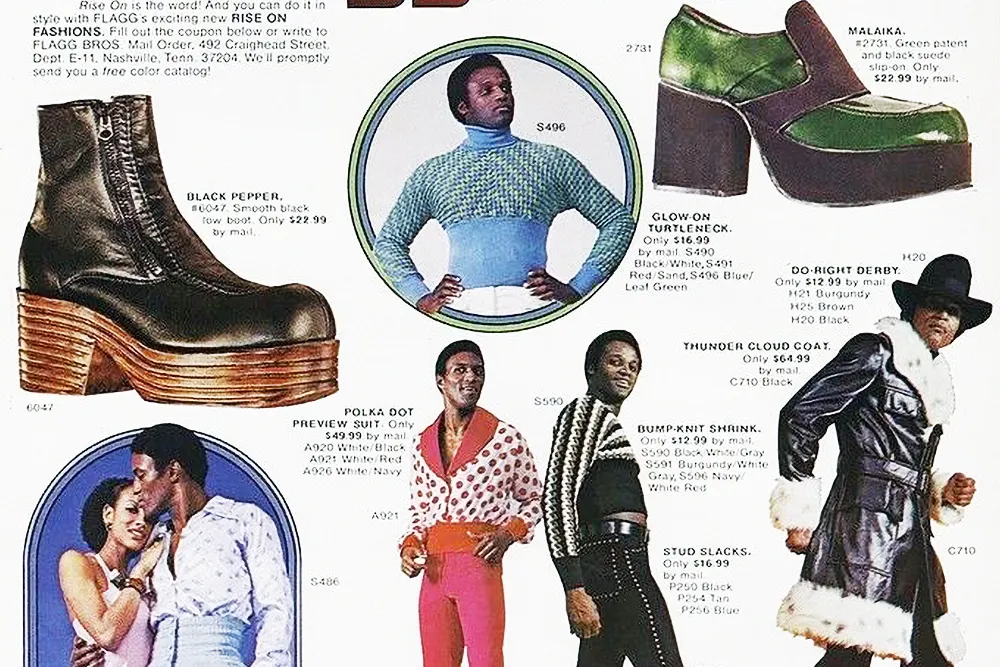
It’s the tragedy of my life that I’d never be able to pull off these looks
“Look here, Brothers! There’s a lot of movin’ to be done! So start making your plans to go places in RISE-ON FASHIONS.”
With ad copy like this, the name Flagg Bros. conjures up an image of super-hip, visionary brothers - presumably also “brothers” in the jive sense - building a street style empire, emblematic of rising Black confidence and purchasing power in the post-Civil Rights 1970s.
Not even close. There were no actual brothers behind Flagg Bros., by either definition. It was a brand name invented in 1936 for a division of the General Shoe Corporation. Flagg Bros. was one of the best-known shoestore chains in America for decades, peddling men’s shoes in hundreds of stores, a fixture of downtowns and shopping malls. There was nothing funky about them. They just knew a lucrative trend when they saw it.
“For the outspoken few”
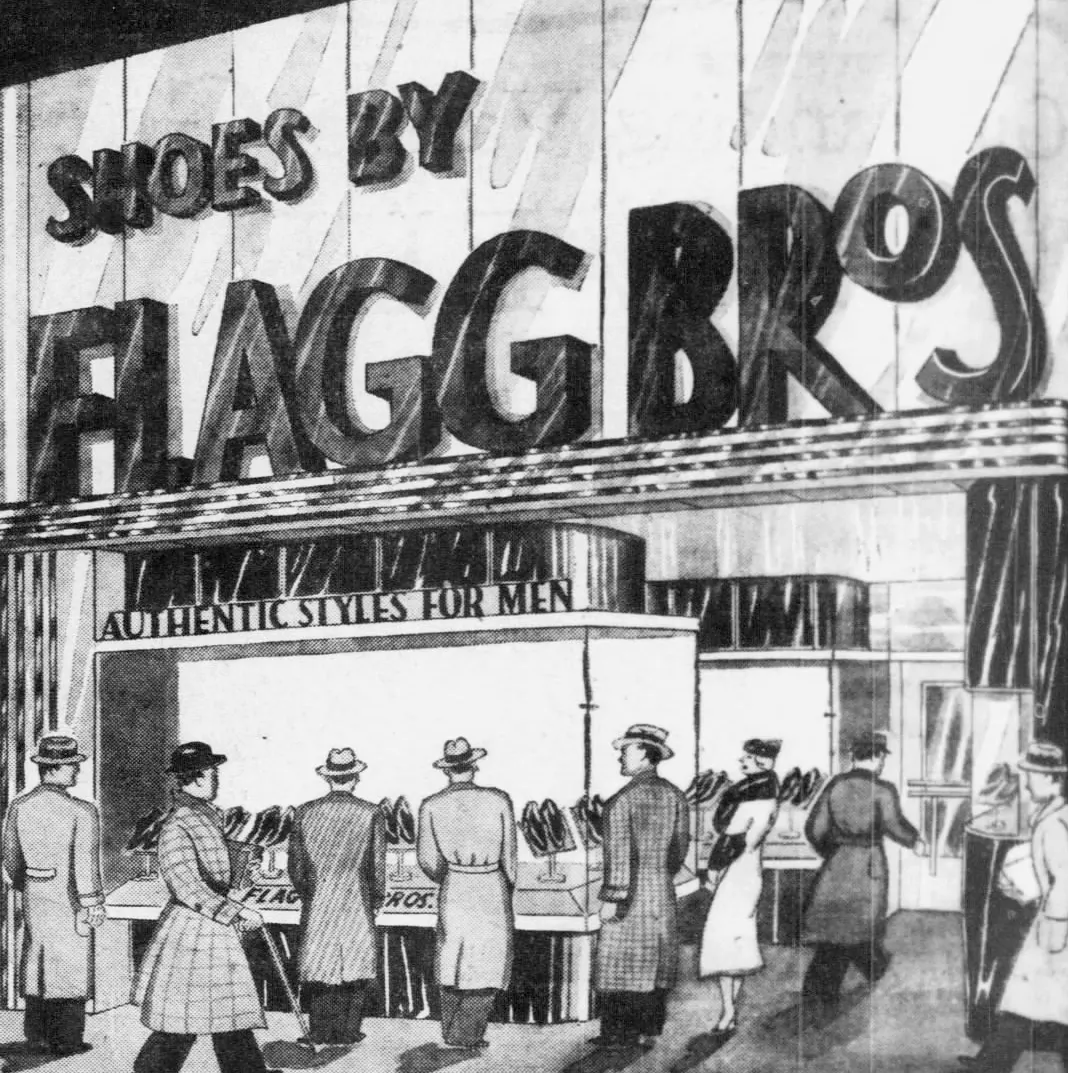
From the 1936 store opening announcement. That’s a regular cane, not a pimp cane.
The Nashville-based General Shoe Corporation launched Flagg Bros. with a store in St. Louis in December 1936, the same week they registered the trademark, and quickly expanded from coast to coast. A generation knew Flagg Bros. as a byword for “nice men’s shoes”, but it was a 1960s trend that made them cool: Beatle Boots. They didn’t make the originals but were fast enough out of the gate that no less an icon than Jimi Hendrix wore Flagg Bros. boots onstage.
In 1970, Flagg Bros. president Rob Cochran found the next big thing on the feet of the London rock ‘n’ roll demimonde when he saw the next logical step after the Cuban-heeled Beatle Boot: men’ s shoes with even higher heels. He brought some back to Tennessee, where a designer named D. Gowan Johnson created a line of shoes with heels up to 3” high.
“Our first big response came from the ethnic groups,” product manager Jack Gallager told the San Francisco Examiner, “and then the rock and rollers, the motorcyclers, and what we call ‘kooky kids’ (hippies).” The Examiner says the shoes were “test marketed on Chicago’s South Side, in the Puerto Rican neighborhoods of New York, and the Watts area of Los Angeles,” in case you were wondering which ethnic groups Gallager was talking about.
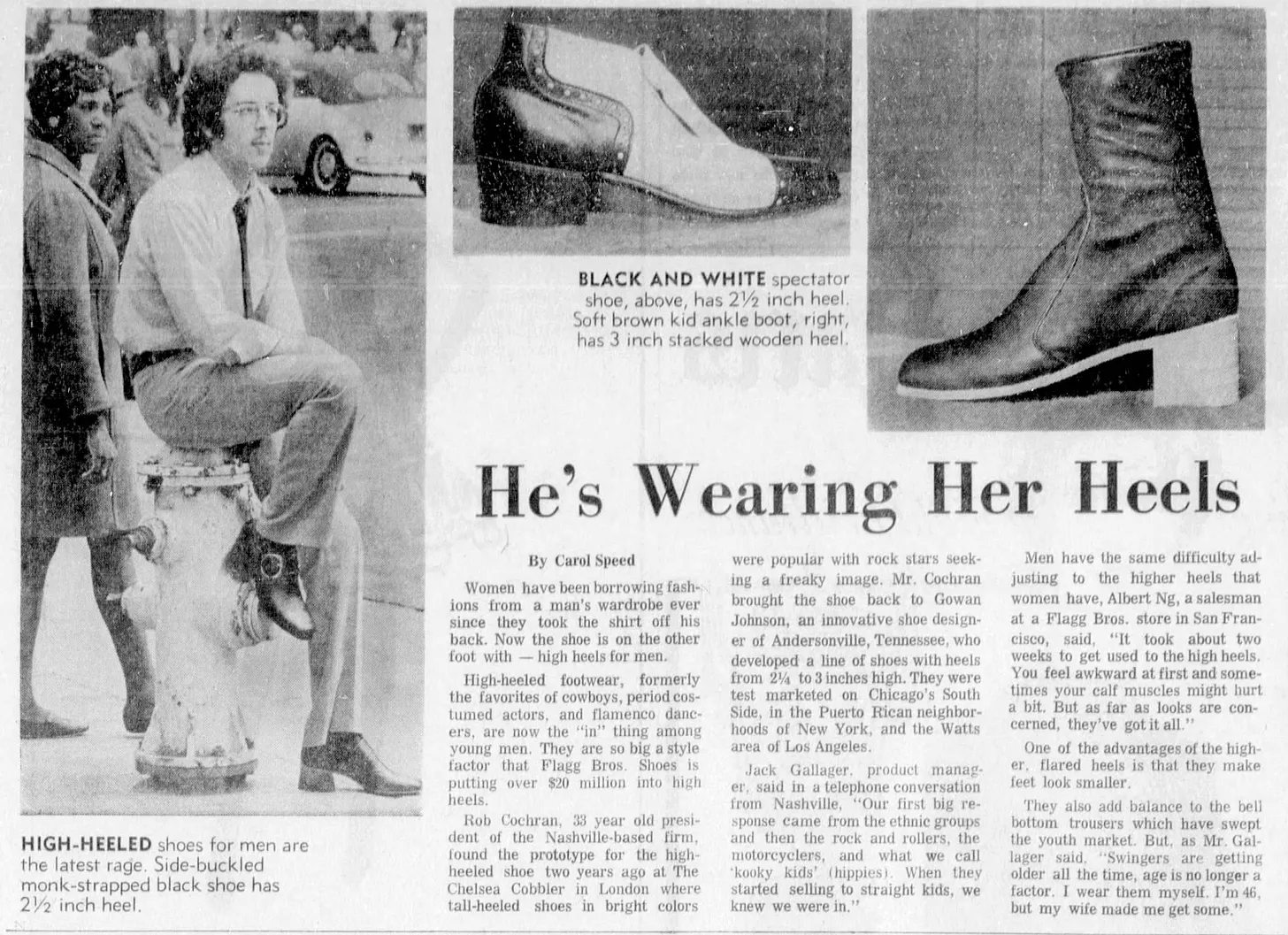
The San Francisco Examiner being footwear-reductionist, 1971
The parent company, now remained Genesco probably because “General Shoe Corporation” was too obviously villainous, was optimistic about high heels catching on with “straight kids” and even non-kids. “Swingers are getting older all the time,” Gallager said. “Age is no longer a factor. I wear them myself. I’m 46, but my wife made me get some.”
But it wasn’t bikers, hippies, and corporate executives born in the 1920s who flocked to the new styles. It was the aforementioned Black and Hispanic men. Flagg Bros. evidently realized they couldn’t talk credibly to these newly assertive, aspirational consumers the same way they would to a White audience, because their mail-order catalog and ads* *suddenly got a whole lot Blacker.
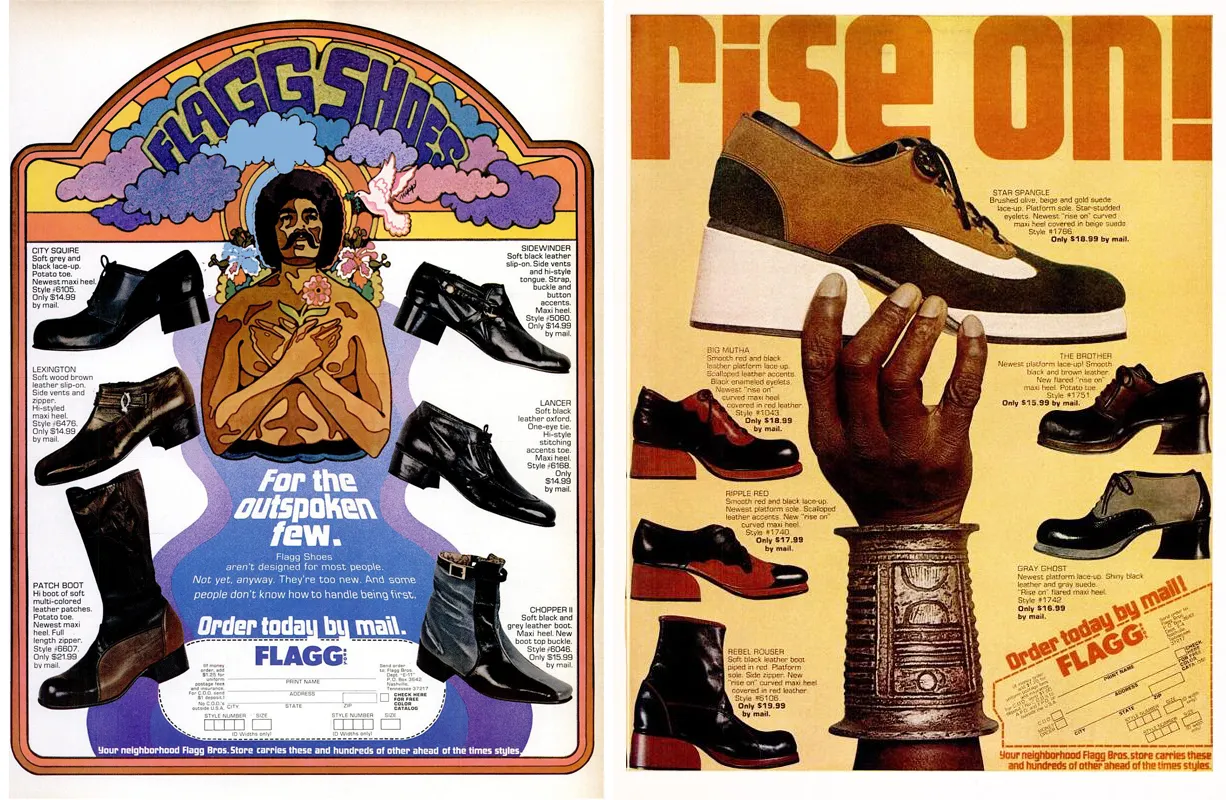
From flower power in ‘71 to soul power in ‘72
This streetwise audience demanded the latest and hippest, so styles evolved fast and went further out than mainstream fashion, White or Black. It wasn’t just the marketing that got more extreme: the shoes did, too. The high heels became platform soles, climbing ever higher along with Flagg Bros. revenue from Black customers.
“Get yourself into the Soul Beat”
Once Flagg Bros. had conquered shoes, they turned their attention to the rest of the outfit, adding a full fashion line in 1972. Again, the only rules were it had to be new, and it had to be bold. Nothing was off-limits, from straw hats to buffalo plaid, from animal prints to Prohibition pinstripes.
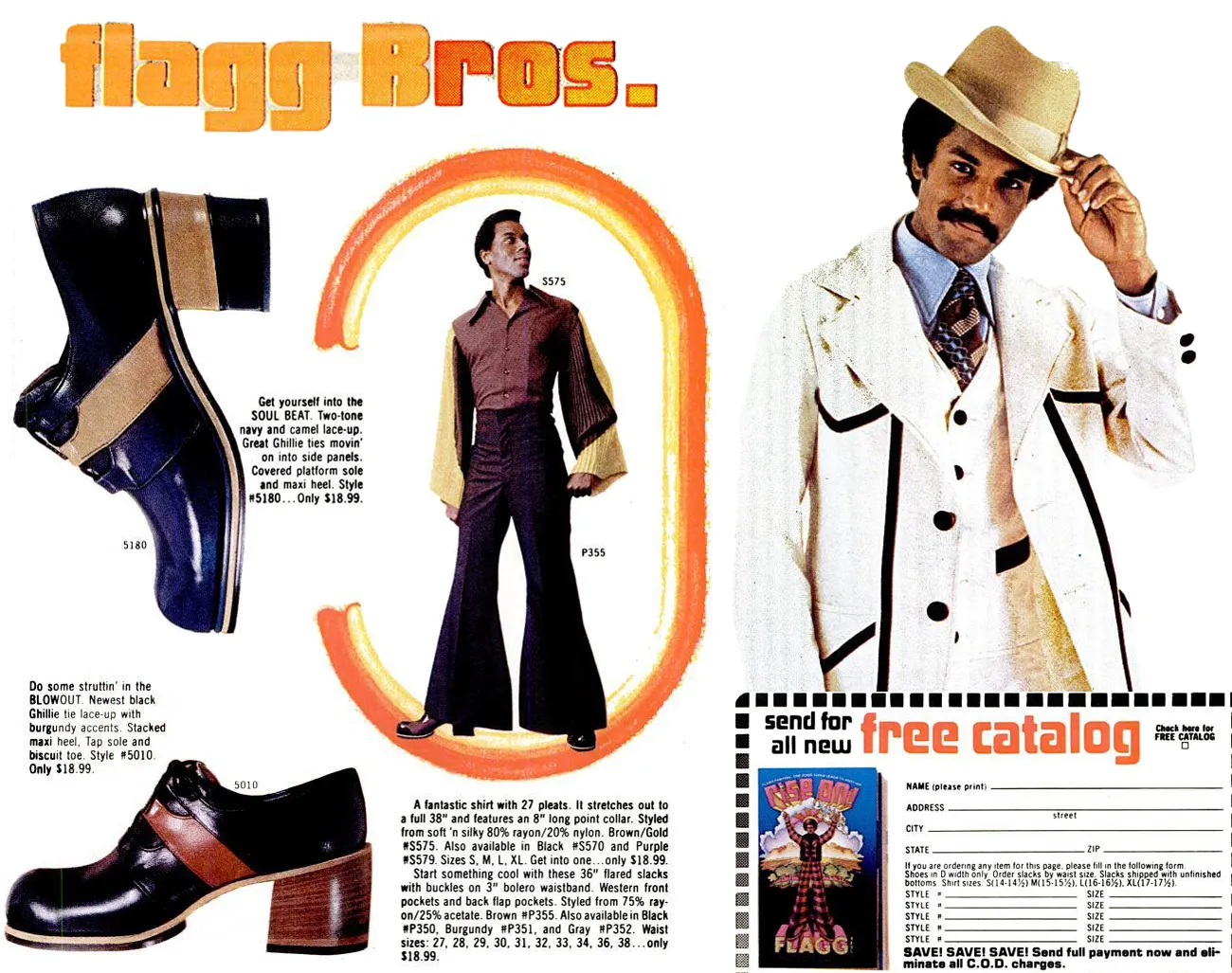
What, didn’t they have any wide bellbottoms?
Their fashions were an even bigger hit than their shoes. “We at FLAGG know we have been giving you the top in shoe fashions,” said one ad. “But the way you’ve let us know that we really have it in clothes, too, is just beautiful… we’ve made our new catalog even bigger to feature many more man-making fashions.”
Up to this point, White companies had often been leery about being successful with Black consumers, lest their White customers think of them as “for Black people.” Flagg Bros. maintained a split personality when marketing to different races. They could advertise to Black audiences in publications like Ebony, send a mail-order catalog full of right-on vibes, and stock stores in Black neighborhoods with these flamboyant styles. Meanwhile, the White customers who shopped at other Flagg Bros. stores were largely unaware of the Superfly revolution.
There were certainly more crass examples of companies co-opting subcultural communities around this time (like “The Man can’t bust our music“). And at least Flagg Bros was serving a taste that more staid fashion houses wouldn’t go near. But it still raises some questions about the difference between exploitation and inclusion in a profit-driven economy.
Not that any of Flagg Bros. customers were troubled by such abstract concerns when they were hitting the town in head-turning ensembles like this.
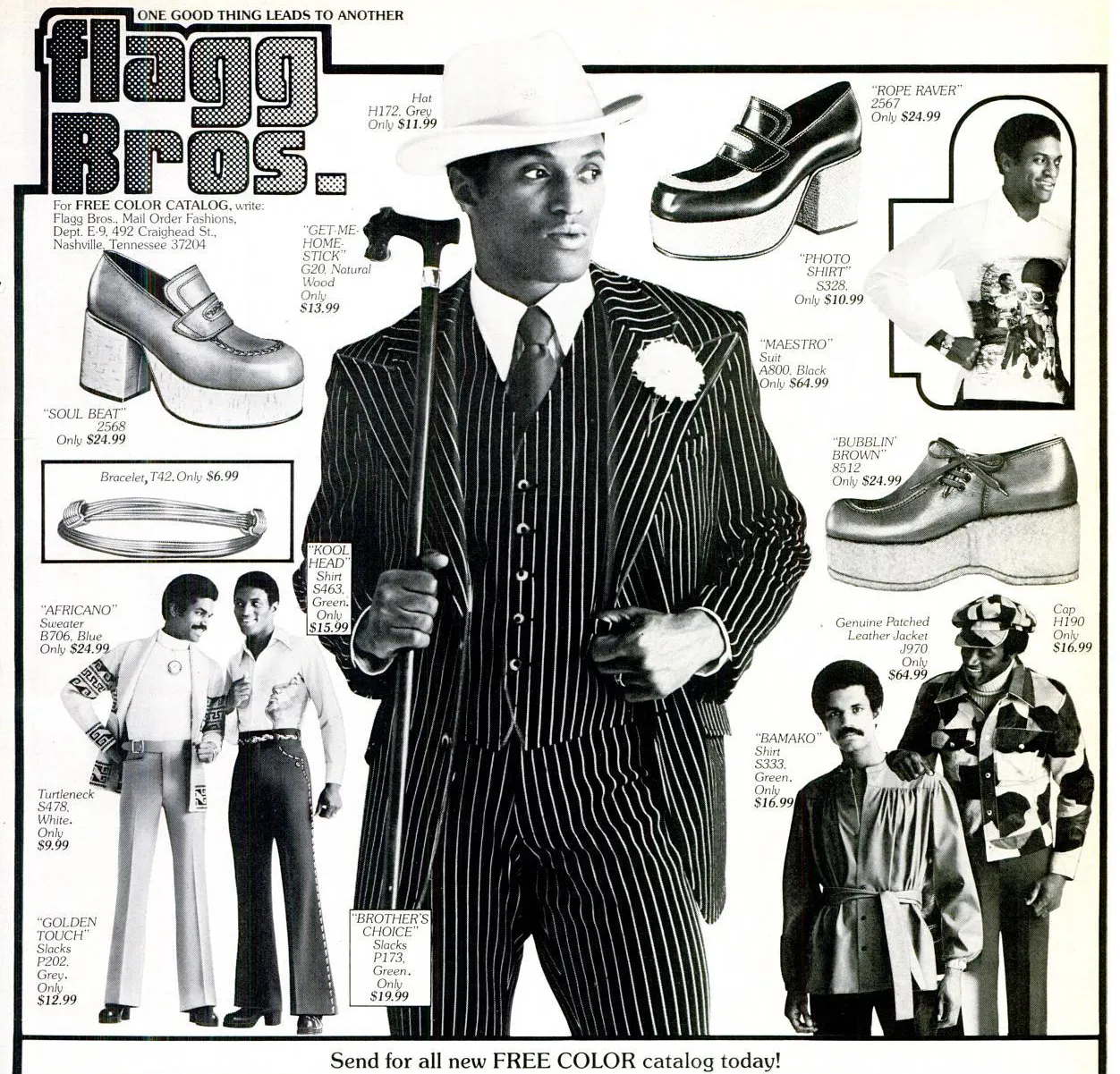
Wear what you dig
“Couldn’t tell us nothin’”
By the end of the ‘70s, the pimp look was aging fast. Different looks were emerging to contend for the cutting-edge Black style of the new decade: dapper upscale formalwear, sleek and shiny futurism, and what we’d come to know as the hip-hop style of caps, sneakers, and baggier fits. None of them had any need for platform shoes or wide-brimmed hats.
To replace the funk look, Flagg Bros. put its bets on dubious new trends, including clogs and cowboy boots. It didn’t help, with either its Black or White clientele. The Ebony ads got smaller and smaller, and the famous catalog fizzled out by 1980. Their mall-store business contracted drastically in the early ‘80s, with a few stalwart stores holding out into the ‘90s before finally closing. There’s very little documentation online of Flagg Bros. in any incarnation - they don’t even have their own Wikipedia page.
But mention Flagg Bros. to Black people of a certain age and the name inspires an amused nostalgia. “Man those were the days. Double Knit Pantsuit with Bellbottoms and Stack Heel Shoes, couldn’t tell us nothin” says one Facebook reminiscer. “My big brother used to have those big, bulbous shoes and white bell bottoms around 1975-’76,” says Redditor Hey_Laaady. “His shoes were a dark purple. I thought they looked like eggplants.” The Flagg Bros. themselves might not have existed, but for a few years, the connection between people and their clothes was real.
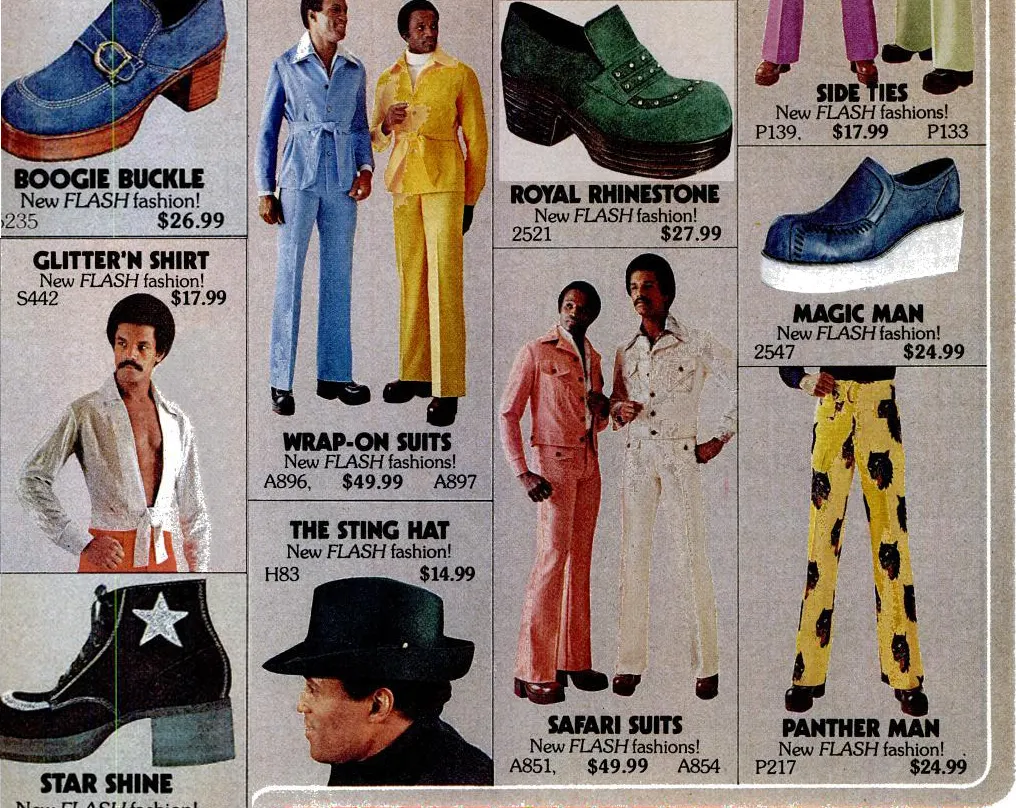
Tag yourself. I’m Panther Man.
I’ve mostly worn pretty straightforward fashion - to the point that if I look at what I was wearing a decade or two ago in pics, aside from some sizing/fitting issues it more or less is what I’m wearing today. Though that might just mean that I got off the fashion bus in the late 90s and am still stuck in plaid flannel and jeans land forever. (My parachute pants era was thankfully short). How about you, did you ride along with any fashion trends in the past? Let’s hear about 'em in this week’s Shoddy Goods chat
—Dave (and the rest of Meh)
previous Shoddy Goods stories:
- With a musk ox here and a musk ox there
- What I learned writing 100 issues of this newsletter
- One man’s quest to collect every Gap instore playlist
And if you like Shoddy Goods, don’t miss Jason’s new other newsletter, Gnomenclature. Every week he digs into the 178-year-history of Hammacher Schlemmer, America’s oddest retailer. It’s gonna get weird!
- 8 comments, 9 replies
- Comment
Were catshirts ever a fashion trend?
@narfcake
/showme @narfcake wearing a catshirt
@narfcake
/showme cats wearing @narfcake shirts
@phendrick Here’s the image you requested for “@narfcake wearing a catshirt”
@phendrick Here’s the image you requested for “cats wearing @narfcake shirts”
@mediocrebot @narfcake Wrong @narfcake, dumb bot
@phendrick I guess I’m female meow?
¯\_(ツ)_/¯
One thing I have noticed with AI is that calicos are rarely represented.
/showme a calico cat holding up a sign proclaiming “I iz not a cat.”
@narfcake Here’s the image you requested for “a calico cat holding up a sign proclaiming I iz not a cat.”
@narfcake
The bot channeling your XX side?
(Good thing it didn’t consider another X?)
The calicoes definitely should lobby for better representation through redistricting; the one shown looks impressive.
Rode the Zubaz trend pretty hard in the early 90’s.
Never heard of these guys. Maybe cuz I’m female. You all have always tended to be male Centric
It wasn’t a trend, but I have college memories of often wearing big olive green military surplus cargo pants with a button down oxford and a Chick Fil A lemonade tie that I talked a manager out of for $20. Sounds ludicrous and it probably was.
Also I’m pretty sure that tie would be worth some significant bucks on eBay. At least it was last time I looked it up. Maybe I should dig it out and sell it.
As for the Flagg Bros, I need the whole fit: glutter’n shirt, panther man pants, and star shine shoes. And no one would want to be seen in public within five yards of me lol
In the late 70’s /early 80’s, I bought some clothes from a similar, but less illustrious store called “Bill the Hatter” by mail order, I ended up with a bright red plaid wool suit and 3" wooden wedge shoes- I really liked those shoes, but wore them out dancing in various discos.
https://www.ghostofthedoll.co.uk/retromusings/bill-the-hatter-adverts-1970s/
I gave up wearing bell bottoms back in the day, but it appears that they came back in style. I won’t wear them again.
@heartny
I still have some pretty wide bottom scrubs from years ago… I’ll wear them occasionally “just for grins”…
Back in the day, I was always more of a Banana Republic guy…
Now it’s mostly t shirts or tropical designs for my button up (“dress”) shirts.
One of my best friends (RIP) used to work in a gas station as a kid outside Buffalo. The owner of the station was friends with the father of the comedian Dick Shawn, his name was Eddie Schulefand. Eddie used to hang out at the gas station shooting the shit and generally being hilarious. He owned a clothing store in downtown Buffalo called “Eddie’s Menswear”. One day my friend was downtown with a friend of his and they saw the store. They figured they’d drop by and harass Eddie. Once they went in the store they realized that all it sold was Pimp wear. Clothes they had never seen in the suburbs (and Eddie never wore). I think they tried on a few pairs of purple men’s high heeled boots and then got out of there.
This would have been sometime in the 1960’s.